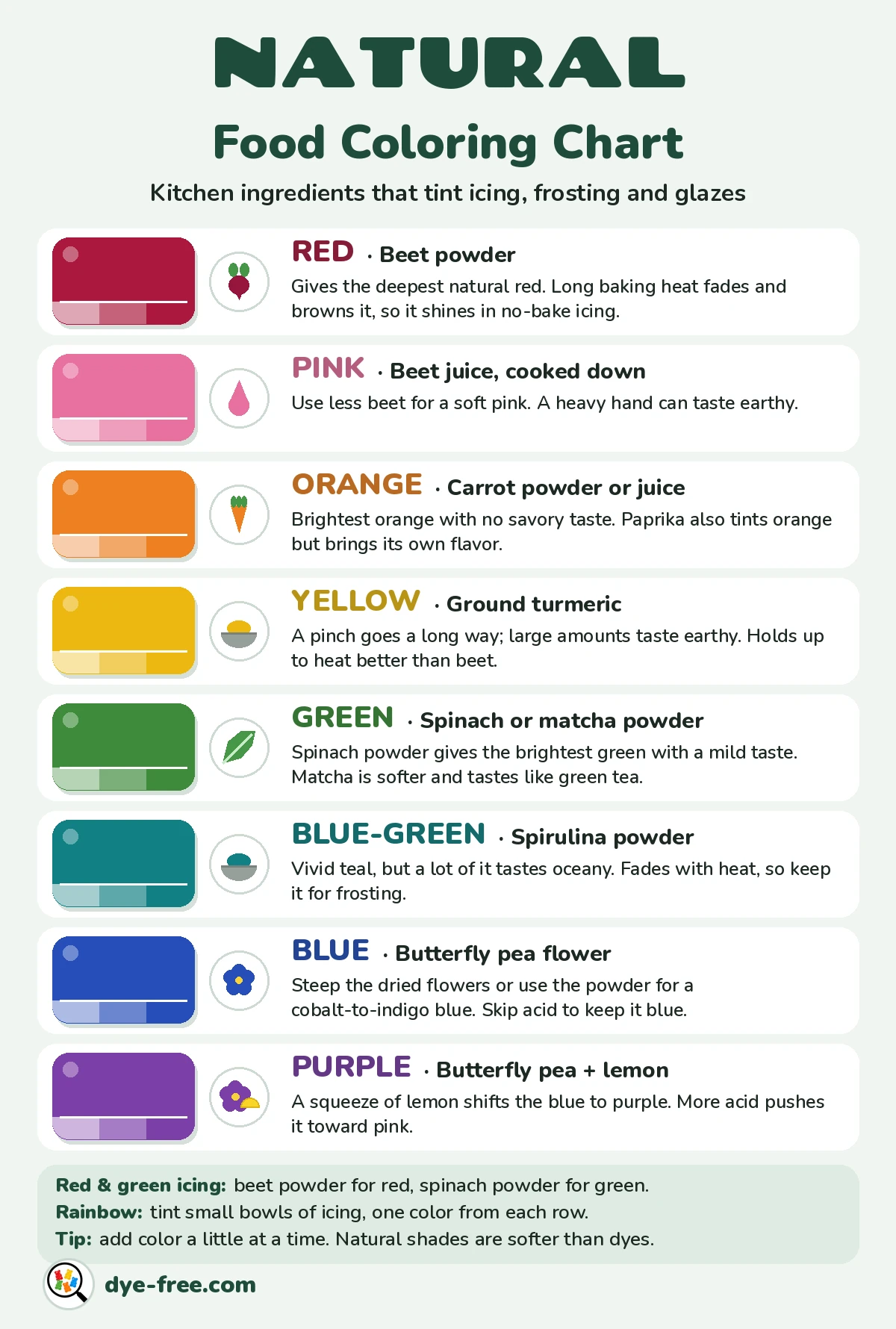
Quick answer: You can make natural food coloring at home in two ways. Powders are freeze-dried fruit, vegetable powders, or spices, and you use 1 to 2 teaspoons per cup of frosting. Liquids are juice or a steeped liquid simmered down from about 1 cup to ¼ cup, and you start with about 1 teaspoon per cup of frosting. Beets make red and pink, carrots and paprika make orange, turmeric makes yellow, matcha or spinach makes green, spirulina makes blue-green, butterfly pea flower makes blue, and butterfly pea plus a squeeze of lemon makes purple. Natural colors come out softer than artificial dyes, and they look best in things that don’t get baked, like frosting, icing, and glazes.
Below you’ll find the full color chart, a section for each color, and what to expect: what fades, what tastes like vegetables, and why lemon turns blue purple.
Want to put these colors to work? See our recipes page for dye-free recipes as we add them.
What you need to know first
- Natural colors are softer. Expect deep rose instead of fire-truck red. Pastels are easy, and bold colors take more product, which brings more flavor.
- Heat dulls most of them. The brightest results are in frosting, icing, glazes, and no-bake treats.
- pH changes the color. Acid pushes many plant colors toward pink or purple, and baking soda pushes them toward blue or green.
- They taste like something. Add color a little at a time, and cool liquids completely before mixing them in.
If you’re checking a store-bought color or snack instead, certified dyes are listed by name. Our food dye guide and the label aliases for Red 40 and friends show every name to look for, and the snacks label guide covers where those colors show up in packaged foods.
Natural food coloring chart
Amounts are starting points for 1 cup of white buttercream or royal icing. Add gradually until you like the shade.
| Color | Source | How to make it | Amount per 1 cup frosting | Heat stability | Taste notes |
|---|---|---|---|---|---|
| Red | Beet powder | Stir straight in, or dissolve in 1–2 tbsp water first | 1–2 tsp | Low: fades and browns when baked | Earthy at higher amounts |
| Pink | Beet juice, cooked down | Simmer 1 cup beet juice down to ¼ cup, then cool | ½–1 tsp | Low | Mild |
| Pink (alt.) | Freeze-dried raspberry or strawberry | Grind to a fine powder, then sift | 1–2 tsp | Low to medium | Fruity, which is a plus |
| Orange | Carrot powder or juice (paprika as a booster) | Powder stirred in, or juice reduced from 1 cup to ¼ cup | 1–2 tsp powder or juice; paprika ⅛ tsp max | Medium | Mild; paprika tastes peppery |
| Yellow | Turmeric (saffron alt.) | Pinch of ground turmeric bloomed in a little water | ⅛–¼ tsp | High | Bitter if you overdo it |
| Green | Spinach or matcha powder | Matcha made into a paste; spinach blended and strained | 1–2 tsp matcha, or 1–2 tsp spinach juice | Medium (matcha browns in long bakes) | Matcha tastes like tea; spinach can taste grassy |
| Blue-green | Spirulina | Dissolve in a few drops of water | ¼–½ tsp | Low: fades with heat | Can taste of the sea at high amounts |
| Blue | Butterfly pea flower powder | Dissolve in 1–2 tbsp water | 1–2 tsp | Medium | Nearly neutral |
| Blue (alt.) | Red cabbage + baking soda | Steep, strain, reduce, then add a pinch of soda | ½–1 tsp | Low | Fine in small amounts; cabbage-y if you use a lot |
| Purple | Butterfly pea + lemon | Butterfly pea liquid plus a few drops of lemon juice | 1–2 tsp powder + ¼–½ tsp lemon | Medium | Slightly tart |
| Purple (alt.) | Blueberry or purple sweet potato | Blueberry reduction, or purple sweet potato powder | 1–2 tsp | Low (blueberry) to medium (sweet potato) | Fruity or mild |
| Brown | Cocoa, espresso | Sift cocoa straight in | 1–3 tbsp cocoa | High | Chocolate or coffee |
| Black | Black cocoa | Sift in, then let it deepen for 1 hour | 2–4 tbsp | High | Like an Oreo |
Powder vs. juice vs. reduction: which method to use
Powders are the easiest and the most reliable choice. They add little or no water, so they won’t thin out your icing, and they keep for months. Buy beet, butterfly pea, carrot, or pitaya powder, or make your own by grinding freeze-dried fruit in a clean spice grinder and sifting out the seeds and bigger bits. If you see specks, dissolve the powder in 1 to 2 tablespoons of water or milk before you add it.
Juices work well for small touches of color. A few drops of beet juice will turn a cup of icing pink. Raw juice is weak and watery, though, so it’s not good for strong colors.
Reductions concentrate juice so you get more color with less liquid. Here’s the basic method:
- Put 1 cup of juice, strained purée, or steeped liquid in a small saucepan.
- Bring it to a gentle boil, then lower the heat and simmer, skimming off any foam.
- Stop at about ¼ cup. Go slowly, because a hard boil dulls the color and can scorch the sugars.
- Cool it completely, then start with about 1 teaspoon per cup of frosting.
Our rule of thumb: for royal icing and anything where texture matters, use a powder. For a soft pastel in glaze or buttercream, either one works.
Natural red and pink food coloring (beet, raspberry, strawberry)
Natural red food coloring comes from beets. Beet powder gives the deepest color with the least liquid. Start with 1 teaspoon per cup of frosting and work up to 2 teaspoons for a deep raspberry red. Past that point, the frosting starts to taste and smell like beets.
Natural pink food coloring from beet juice: simmer 1 cup of beet juice (bottled is fine, or juice from cooked beets that you’ve blended and strained) down to ¼ cup. Use ½ to 1 teaspoon per cup of frosting for a bright pink.
Raspberry or strawberry: freeze-dried berries ground into powder give a soft, fruity pink. Use 1 to 2 teaspoons per cup and sift out the seeds. You can also make a liquid: simmer 2 cups of raspberries with ¼ cup water for about 5 minutes, strain, and reduce to ¼ cup.
Honest note: beet fades when you bake it. Beet color (betalains) breaks down in the oven, so a pink batter often comes out tan or brown. A little acid, like buttermilk or a teaspoon of lemon juice, helps hold the color. You’ll still get a muted, rosy crumb rather than a bright red one. Our upcoming red velvet without food coloring recipe shows exactly what to expect.
For holiday cookies, beet red and berry pink make great icing colors. See our naturally colored sugar cookie icing.
Natural orange food coloring (carrot, paprika, sweet potato)
Carrot gives a gentle apricot orange. Use 1 to 2 teaspoons of carrot powder per cup, or reduce 1 cup of carrot juice to ¼ cup and use 1 to 2 teaspoons of that.
Paprika deepens the color, but go easy. More than ⅛ teaspoon per cup and you’ll taste it. Sweet (not smoked) paprika is the one to use for sweets.
Sweet potato: 1 to 2 tablespoons of smooth, strained orange sweet potato purée gives a soft orange to buttercream. Because purée adds body, it works best in cream cheese frosting or fillings, not thin glazes.
Natural yellow food coloring (turmeric, saffron)
Turmeric is the strongest natural color you can buy. It’s also one of the few that holds up well in the oven. Start with just ⅛ teaspoon per cup of frosting, bloomed in a teaspoon of warm water. Too much tastes bitter and earthy. Turmeric stains counters, spatulas, and shirts, so wear an apron.
pH note: turmeric shifts toward orange-red in alkaline mixtures, like batters with a lot of baking soda. If your yellow cake comes out a little orange, that’s why.
Saffron gives a golden yellow with a gentle floral flavor. Steep a pinch (10 to 15 threads) in 1 tablespoon of warm water for 15 minutes, then add the liquid. It’s pricey, so save it for breads, custards, and rice, where the flavor belongs.
Natural green food coloring (matcha, spinach, spirulina)
Matcha gives a soft sage-to-jade green. Make a paste with 1 teaspoon matcha and 2 tablespoons water, then use 1 to 2 teaspoons of matcha per cup of frosting. Culinary-grade matcha works fine. It tastes like green tea, which goes nicely with vanilla and white chocolate.
Spinach gives a brighter, grassier green. Blend 1 packed cup of fresh spinach with 2 tablespoons of water, strain it through a fine sieve or cheesecloth, and use 1 to 2 teaspoons of the juice per cup. Honest note: spinach can taste grassy in a mild frosting. Use only as much as you need, and pair it with mint, lemon, or vanilla.
Spirulina (blue-green): regular green spirulina powder gives a teal, blue-green color. Dissolve ¼ to ½ teaspoon in a few drops of water first. It has a sea-like flavor in larger amounts, and its color fades with heat, so use it only in no-bake things.
These greens are what we use for Christmas trees and wreaths. Try our natural green frosting.
Natural blue food coloring (butterfly pea flower, red cabbage)
Butterfly pea flower powder is the easiest natural blue. Dissolve 1 to 2 teaspoons in 1 to 2 tablespoons of water per cup of frosting. It tastes nearly neutral. For a deep navy blue you’d need a lot of powder, so expect sky blue to periwinkle. Dried butterfly pea flowers steeped in hot water make a blue tea you can reduce for drinks and gelatin.
Red cabbage blue (the kitchen science trick):
- Simmer 2 cups shredded red cabbage with 1½ cups water, then take it off the heat and let it steep for 15 minutes.
- Strain, then reduce the purple liquid to 3 to 4 tablespoons.
- Stir in a small pinch of baking soda, no more than ¼ teaspoon. It’ll foam and turn blue.
- Cool, then use ½ to 1 teaspoon per cup of icing.
Too much baking soda tastes soapy and salty, and a heavy hand with the dye tastes like cabbage. In a cup of sweet icing, small amounts are undetectable.
Natural purple food coloring (butterfly pea + lemon, blueberry, purple sweet potato)
Butterfly pea plus lemon is our favorite trick. Make butterfly pea blue as above, then stir in a few drops of lemon juice (start with ¼ teaspoon). The acid turns it violet, and more lemon pushes it toward magenta. It’s the same pigment as the blue, just at a different pH.
Blueberry: simmer 2 cups of blueberries with ¼ cup water until they burst, mash, strain, and reduce to ¼ cup. Use 1 to 2 teaspoons per cup for a lavender-purple. Watch the pan, because blueberry scorches and browns easily.
Purple sweet potato powder (ube powder works too) gives a steady violet that holds up a bit better in baking. Use 1 to 2 teaspoons per cup.
pH note: blueberry and cabbage colors look reddish in acidic recipes, like lemon glaze or cream cheese frosting, and bluish-gray in alkaline ones, like batters heavy on baking soda. If your purple turns gray-green in the oven, the baking soda did that.
Natural brown and black food coloring (cocoa, and a caution about charcoal)
Brown is easy. Natural or Dutch-process cocoa (1 to 3 tablespoons per cup of frosting) or a teaspoon of dissolved instant espresso gives warm browns that hold up in the oven.
Black: black cocoa gets you closest to black naturally. Use 2 to 4 tablespoons per cup and let the frosting sit for an hour, since it darkens as it rests. It tastes like an Oreo cookie, which most people love.
A caution about activated charcoal. You’ll see activated charcoal in a lot of “naturally black” recipes. We don’t use it on this site. Activated charcoal is used medically because it binds things in the gut, and it can reduce how well some medications are absorbed, including some birth control pills and certain heart and seizure medications. The small amount in a batch of frosting is usually a modest concern. Still, if you or your guests take any regular medication, check with a pharmacist first. Black cocoa is the easier choice.
How to store homemade food coloring
- Liquids and reductions: keep in a clean, airtight jar in the fridge and use within about 1 week. They lose color as they sit, and cabbage dye gets more cabbage-y. Throw out anything that smells off or grows mold.
- Freeze for later: freeze liquids in ice cube trays (about 1 tablespoon each) for up to 1 month. Thaw and stir before using.
- Powders: keep airtight in a cool, dark cupboard. Light and humidity are what fade them. Freeze-dried fruit powders soak up moisture and clump, so add a food-safe desiccant packet or keep them in the freezer. Store-bought powders keep until the date on the package.
- Colored frosting: natural colors fade in strong light. Decorate as close to serving time as you can, and keep finished cookies out of direct sun.
Using natural colors in baking, drinks, and candy
- Batter and dough: turmeric, cocoa, matcha, and purple sweet potato hold up best. Beet, spirulina, and berry colors usually fade. Adding color after baking (with icing, glaze, or dusting) always looks brighter.
- Gelatin and drinks: fruit juices give you color with no extra work. Our dye-free fruit juice jello uses only juice. Keep butterfly pea away from acidic juices unless you want purple.
- Sprinkles: tint royal icing, pipe thin lines, let them dry, and chop. See homemade natural sprinkles.
For packaged party and school treats, see our dye-free party and school snack ideas.
Frequently asked questions
How do you make natural food coloring at home?
Use a powder (freeze-dried fruit, vegetable powder, or a spice like turmeric) or a liquid reduction (juice simmered from 1 cup down to ¼ cup). Start with 1 to 2 teaspoons of powder or about 1 teaspoon of reduction per cup of frosting, then add more slowly until you like the color.
What can I use instead of red food coloring?
Beet powder or cooked-down beet juice gives the strongest natural red. Freeze-dried raspberry or strawberry powder gives a pink-red with a fruity taste. Expect a deep rose or raspberry shade rather than a bright artificial red.
Does beet food coloring taste like beets?
Not in small amounts. Up to about 1 teaspoon of beet powder per cup of frosting is hard to notice. At 2 teaspoons or more you may taste or smell a little earthiness, and vanilla or berry flavors help cover it.
Can you bake with natural food coloring?
Yes, but many colors fade or brown in the oven. Turmeric, cocoa, matcha, and purple sweet potato hold up best. Beet, spirulina, and berry colors usually fade, so it’s best to add those colors in icing or glaze after baking.
How do you make blue food coloring naturally?
Dissolve butterfly pea flower powder in a little water, or simmer red cabbage, reduce the liquid, and stir in a small pinch of baking soda to turn it from purple to blue. Use ½ to 2 teaspoons per cup of icing, depending on the method.
Why did my natural food coloring change color?
Most likely pH. Plant colors like butterfly pea, red cabbage, and blueberry turn pink or purple with acid (lemon, cream cheese, buttermilk) and blue or green with baking soda. Heat and light can also fade natural colors over time.
How long does homemade food coloring last?
Liquid colorings keep about 1 week in the fridge, or up to 1 month frozen in ice cube trays. Dry powders keep for months in an airtight container in a cool, dark place.
Is activated charcoal safe to use as black food coloring?
Small amounts are generally considered low risk for most people, but activated charcoal can reduce how well some medications are absorbed. If you take regular medication, ask a pharmacist first. Black cocoa is an easy alternative.
Ready to bake? Browse our dye-free recipes as we add them, or use the colors above in frosting and icing.